
Thank you for Subscribing to Business Management Review Weekly Brief


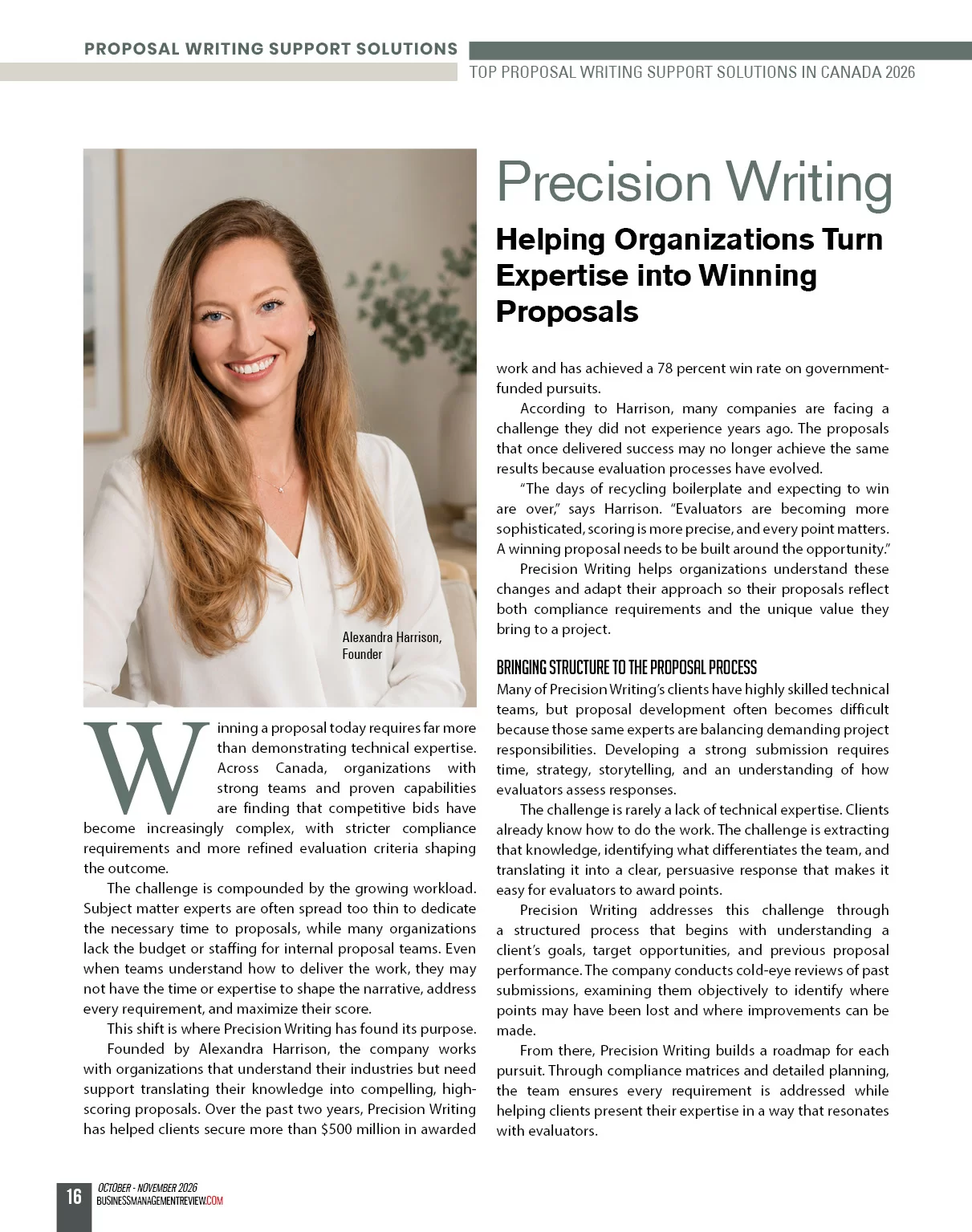
 Alexandra Harrison, Founder
The challenge is compounded by the growing workload. Subject matter experts are often spread too thin to dedicate the necessary time to proposals, while many organizations lack the budget or staffing for internal proposal teams. Even when teams understand how to deliver the work, they may not have the time or expertise to shape the narrative, address every requirement, and maximize their score.
This shift is where Precision Writing has found its purpose.
Founded by Alexandra Harrison, the company works with organizations that understand their industries but need support translating their knowledge into compelling, high-scoring proposals. Over the past two years, Precision Writing has helped clients secure more than $500 million in awarded work and has achieved a 78 percent win rate on government-funded pursuits.
According to Harrison, many companies are facing a challenge they did not experience years ago. The proposals that once delivered success may no longer achieve the same results because evaluation processes have evolved.
“The days of recycling boilerplate and expecting to win are over,” says Harrison. “Evaluators are becoming more sophisticated, scoring is more precise, and every point matters. A winning proposal needs to be built around the opportunity.”
Precision Writing helps organizations understand these changes and adapt their approach so their proposals reflect both compliance requirements and the unique value they bring to a project.
Bringing Structure To The Proposal Process
Many of Precision Writing’s clients have highly skilled technical teams, but proposal development often becomes difficult because those same experts are balancing demanding project responsibilities. Developing a strong submission requires time, strategy, storytelling, and an understanding of how evaluators assess responses.
The challenge is rarely a lack of technical expertise. Clients already know how to do the work. The challenge is extracting that knowledge, identifying what differentiates the team, and translating it into a clear, persuasive response that makes it easy for evaluators to award points.
Precision Writing addresses this challenge through a structured process that begins with understanding a client’s goals, target opportunities, and previous proposal performance. The company conducts cold-eye reviews of past submissions, examining them objectively to identify where points may have been lost and where improvements can be made.
From there, Precision Writing builds a roadmap for each pursuit. Through compliance matrices and detailed planning, the team ensures every requirement is addressed while helping clients present their expertise in a way that resonates with evaluators.
The company works closely with subject matter experts because they hold the technical knowledge needed to deliver projects.
Precision Writing’s role is to draw that knowledge out efficiently and turn it into responses that are clear, strategic, evidence-based, and aligned with scoring expectations. By managing the pursuit process, developing win themes, maintaining compliance, and shaping technical information into evaluator-focused content, Precision Writing allows subject matter experts to contribute where their knowledge adds the greatest value without requiring them to become proposal specialists themselves.
More Than Proposal Writing
Precision Writing’s scope extends beyond writing the final document. For organizations without dedicated proposal staff, the company can function as an extension of the internal team, managing the pursuit process from kickoff through submission while allowing technical experts to focus their time where it adds the most value.
Clients receive customized responses and materials that can support future submissions. Precision Writing also helps build internal capability through guidance, training, templates, and reusable content resources. The process helps internal teams better understand proposal management, allowing them to approach future opportunities with greater confidence.
For organizations that require a more polished presentation, Precision Writing provides design support through both Word-based proposals and more visually refined InDesign submissions. This combination allows clients to create documents that are not only accurate but also easier for evaluators to navigate.
Understanding How Procurements Are Built and Scored
A major differentiator for Precision Writing is its experience not only responding to procurements, but also helping owners develop them. The company has developed RFPs and scoring frameworks and advised owners on procurement strategy, providing insight into how requirements and evaluation criteria are structured before a proposal ever reaches an evaluator.
That perspective directly influences how Precision Writing approaches a submission. Rather than simply answering each question, the team considers how an evaluator will find the information, interpret the evidence, and ultimately assign points. Responses are structured to make compliance clear, substantiate claims, and connect a client’s strengths directly to the evaluation criteria.
-
The days of recycling boilerplate and expecting to win are over. Evaluators are becoming more sophisticated, scoring is more precise, and every point matters. A winning proposal needs to be built around the opportunity.
Harrison sees artificial intelligence as a valuable efficiency tool, but not a substitute for proposal strategy. “AI can help teams work faster, but it can't fix a weak pursuit strategy, generic boilerplate, or a response that doesn't understand how the evaluator is awarding points.” Precision Writing combines technology with strong frameworks, quality content, and human expertise to create submissions that remain specific to the client and the opportunity.
Helping Clients Achieve Growth
One client success story highlights the company’s impact. A smaller Saskatchewan organization with significant technical expertise was pursuing a major mining contract but lacked confidence in its proposal capabilities. Precision Writing reviewed its previous submissions, identified communication gaps, and guided the team through the entire process.
Precision Writing supported the pursuit from proposal development through presentations and interview preparation, helping the organization communicate its technical strengths and compete effectively for an opportunity of significant scale. The result was a successful award of a $250 million mining contract, creating a major growth opportunity for the client and establishing a long-term partnership with Precision Writing.
Building For The Future
Precision Writing continues to grow carefully, focusing on expanding capacity while maintaining the quality standards that define its work. The company’s future plans include supporting more organizations across Canada and expanding further into U.S. procurement markets.
For Precision Writing, growth is not simply about handling more proposals. It is about helping organizations compete more effectively in an environment where every point matters and where exceptional proposals can create exceptional opportunities. Whether an organization needs support on a must-win pursuit, wants to improve an underperforming proposal process, or simply does not have the internal capacity to manage increasingly complex submissions, Precision Writing provides the strategy, structure, writing, and guidance needed to compete more effectively.
Matching Proposal Support to Evaluation Demands
Proposal scoring has become less forgiving even for firms that know how to deliver the work. Public agencies and other RFP issuers are tightening compliance requirements while making evaluation frameworks more detailed. A proposal that once won on technical credibility and familiar boilerplate can now lose points because the response does not map cleanly to the evaluator’s scoring logic. That shift changes what buyers should expect from proposal writing support. The service has to do more than improve prose. It must help a pursuit team translate technical knowledge into a response that answers the solicitation exactly and makes its evidence easy to evaluate.
Workload is the first pressure point. Subject matter experts are often balancing active project responsibilities against proposal deadlines, and many firms cannot justify a large internal proposal team for uneven pursuit volume. External support should therefore reduce the drafting burden placed on technical staff without stripping them of control over the substance. A capable provider should shape the response and draw useful information from specialists rather than hand them a blank page. That distinction matters because outsourced writing can still consume too much internal time when the provider depends on the client to structure every answer. Review ownership also deserves attention. Clear checkpoints help prevent proposal managers from spending scarce hours reconciling conflicting edits late in the schedule.
“PRECISION WRITING’S TEAM USES COLD-EYE REVIEWS TO IDENTIFY SCORING GAPS, AND THEN APPLIES STRUCTURED RESPONSE FRAMEWORKS THAT GUIDE TECHNICAL EXPERTS THROUGH ACTIVE PURSUITS.”
Scoring discipline matters just as much as writing quality. Buyers should look for a process that breaks an RFP into explicit requirements and tracks each response against them throughout development. Strong support also examines prior submissions for missed points and recurring weaknesses. Reusing old content without that scrutiny can create false efficiency. Procurement teams are becoming more alert to generic language, while evaluation criteria increasingly reward direct evidence tied to the question being scored. Page limits raise the bar further. A response must make its strongest evidence visible without allowing design or unnecessary explanation to crowd out material that earns points.
“Precision Writing’s team uses cold-eye reviews to identify scoring gaps, and then applies structured response frameworks that guide technical experts through active pursuits.”
AI adds another buying complication. General-purpose tools can accelerate drafting, but volume is not the same as relevance. Proposal teams need a clear response framework before automation becomes useful, especially when source material is uneven or outdated. A provider should be able to distinguish reusable content from material that requires fresh tailoring and know when generic drafting introduces evaluation risk. The better test is whether the service leaves the client with a stronger proposal process after the engagement, not merely a completed document. Templates and reusable content have value only when teams understand how to adapt them to a new evaluator’s requirements.
Precision Writing merits close consideration for organizations facing heavier pursuit loads and tighter scoring. Its team uses cold-eye reviews to identify scoring gaps, and then applies structured response frameworks that guide technical experts through active pursuits. Compliance matrices keep requirements visible throughout development, while customized training helps internal teams improve future submissions. Its writers bring experience from proposal development and evaluation, giving the engagement a view of both sides of the procurement process. Clients retain the content created during the work, which can strengthen their internal library rather than create dependence on outside drafting. For firms without deep proposal staffing or those adding support for major pursuits, Precision Writing offers a disciplined way to improve submission quality while preserving technical ownership.
...Read more
Proposal Writing Support Solutions in Canada Info
Q1
What Do Proposal Writing Support Solutions in Canada Typically Cover?
Proposal Writing Support Solutions in Canada can cover strategy, writing, review, compliance tracking, proposal management and document design. The work is especially relevant when a bid involves detailed requirements, formal scoring criteria or a large amount of technical input. Support can range from improving individual responses to managing a pursuit from kickoff through submission. The goal is to make the response easier to evaluate while ensuring required information is addressed clearly and consistently.
Q2
How Does Precision Writing Approach Complex Procurements?
Precision Writing works with organizations that already have technical expertise but need structured support to turn that knowledge into a competitive submission. Its process includes cold-eye reviews of previous proposals, compliance matrices and pursuit roadmaps. The company also helps develop win themes and works directly with subject matter experts to extract useful technical information. Its experience includes developing RFPs and scoring frameworks, giving it exposure to how procurements are structured as well as how proposals are evaluated.
Q3
What Problems Can Proposal Writing Support Solutions in Canada Help Address?
Proposal Writing Support Solutions in Canada can reduce the drafting burden on subject matter experts who are balancing active project work with bid deadlines. They can also help organizations address missed requirements, weak evidence, inconsistent responses and excessive reliance on reused material. A structured process can separate reusable content from information that needs fresh tailoring. This matters when evaluation criteria are detailed and points depend on how directly a response answers the requirement.
Q4
What Should Buyers Look For in Proposal Support?
Organizations evaluating Proposal Writing Support Solutions in Canada should examine more than writing quality. Useful factors include experience with procurement requirements, a defined review process, compliance tracking, subject matter expert coordination and the ability to connect evidence to scoring criteria. Buyers should also consider whether the provider improves the organization’s internal process rather than simply producing a finished document. Training, templates and reusable content can be useful when they help teams handle future submissions with less external support.
Q5
How Can Technology Fit Into Proposal Development?
Proposal Writing Support Solutions in Canada can use technology to accelerate drafting and organize information, but tools do not replace proposal strategy or source knowledge. Precision Writing uses artificial intelligence as an efficiency tool while maintaining human review and structured frameworks. Its approach emphasizes specificity to the client and opportunity rather than generic boilerplate. For complex bids, the practical question is whether technology helps the team produce relevant, evidence-based responses without weakening accuracy, compliance or evaluator focus.
Q6
How Can Proposal Writing Support Solutions in Canada Affect Business Development?
Proposal Writing Support Solutions in Canada can support business development when strong technical capabilities need to be communicated effectively during competitive procurements. Precision Writing reports that its clients have secured more than $500 million in awarded work over the past two years, with a 78 percent win rate on government-funded pursuits. The profile also describes a Saskatchewan client that won a $250 million mining contract after receiving support across proposal development, presentations and interview preparation. These examples illustrate how proposal support can extend beyond writing into pursuit management and preparation.
Company :
Precision Writing
ManagementAlexandra Harrison, Founder
Description
Precision Writing helps technical organizations win complex competitive procurements through proposal strategy, management, writing, review, and design. Working as an extension of clients’ internal teams, the company transforms technical expertise into clear, compliant, evaluator-focused submissions designed to maximize scoring and improve win rates.