



Rinaldo Veseliza
If you're designing a sustainable data center, the goal is to minimize energy, water, carbon emissions, and waste while maintaining reliability, performance, and scalability. However, the recent protests against Data Center development are a reason to look for better cooperation with communities to develop centers which have benefits for the community Below is a practical framework used by leading operators such as Microsoft, Google, AWS, Equinix, and Digital Realty.
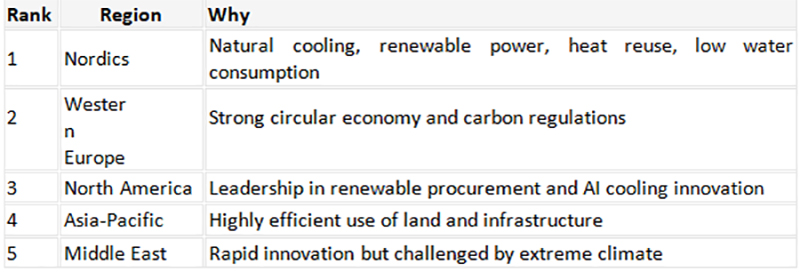
Which Region Has the Most Sustainable Design?
Ranking by overall sustainability maturity:
Key Lesson
The world's most sustainable data centers are increasingly combining elements from multiple regions:
• Nordic natural cooling and heat recovery
• North American renewable-energy scale
• European circular-economy practices
• Asian high-density engineering
• Middle Eastern water-efficiency innovations
For a new AI-focused data center in California, the optimal design would likely blend Nordic-inspired heat reuse where practical, North American renewable-energy procurement, and advanced liquid cooling, targeting a PUE below 1.2, near-zero water consumption, and 24/7 carbon-free energy operation.
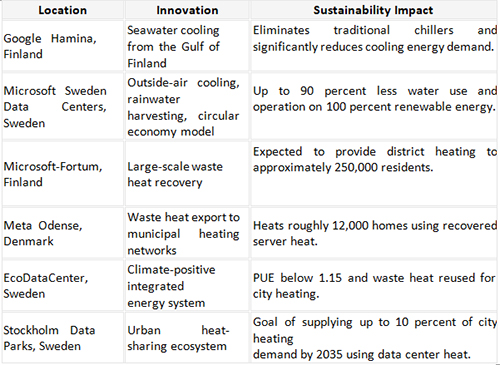
Around the world, the most innovative sustainable data centers are moving beyond simple energy efficiency. They are becoming integrated energy systems that reuse waste heat, eliminate freshwater consumption, leverage natural cooling resources, and operate on 100 percent renewable energy.
Global Leaders in Sustainable Data Center Design
Sustainable Data Center Design Framework
1. Site Selection
Choose locations that naturally reduce energy consumption.
Key criteria
• Access to renewable energy sources (solar, wind, hydro, geothermal)
• Cool climates to reduce cooling requirements
• Low water-stress regions
• Proximity to sewage treatment plants or new plants
• Reliable utility infrastructure
• Proximity to network backbones and major users to supply alternate energy sources
Best practices for Design and Approval
• Target communities with needs for approvals and involve in participation
• Focus on capturing and identifying priorities for community
• Identify community leaders with support for economic development, Job opportunities, and community infrastructure needs.
• Offer opportunities which will benefit the community as a partner in growth
• Co-locate near renewable generation or renewable energy purchase opportunities
• Evaluate climate risks such as wildfire, flooding, and extreme heat
• Identify and Incorporate Sustainability practices which are most appropriate to the area
• Look at the larger community infrastructure needed for successful implementation of upgrades which would benefit the community at large:
• Upgrading power grid
• Adding water treatment facilities for recycling wastewater
• Adding solar or wind infrastructure
• Planning with city, county and State agencies for community benefit
They are becoming integrated energy systems that reuse waste heat, eliminate freshwater consumption, leverage natural cooling resources, and operate on 100 percent renewable energy.
Example: Next-Generation Sustainable AI Data Center
Capacity: 50 MW
Features
• 100 percent renewable electricity
• Direct-to-chip liquid cooling
• Battery energy storage system
• AI-driven DCIM platform
• Rainwater recovery
• Waste heat reuse
• Modular construction
Expected Results
• PUE: 1.10-1.15
• Water reduction: 70-90 percent
• Carbon reduction: >90 percent compared to conventional facilities
• Operating cost reduction: 20-40 percent
Recommended Design Priorities
1.Design around renewable energy availability.
2. Use liquid cooling for high-density AI workloads.
3. Target PUE below 1.2.
4. Minimize water consumption through closed-loop systems.
5. Implement AI-driven monitoring and optimization.
6. Measure both operational and embodied carbon.
7. Plan for reuse, recycling, and equipment lifecycle management from day one.
This approach aligns with current best practices used by hyperscale data center operators pursuing net-zero and carbon-negative infrastructure goals.
 Around the world, the most innovative sustainable data centers are moving beyond simple energy efficiency. They are becoming integrated energy systems that reuse waste heat, eliminate freshwater consumption, leverage natural cooling resources, and operate on 100 percent renewable energy.
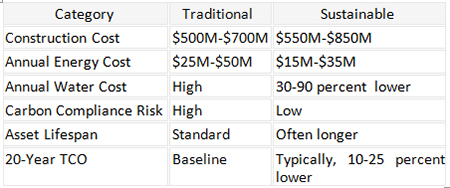
Total Cost of Ownership Comparison
For a hypothetical 50 MW data center:
A sustainable facility may cost 10 percent -20 percent more initially, but can reduce lifetime operating costs by hundreds of millions of dollars.
