
Thank you for Subscribing to Business Management Review Weekly Brief


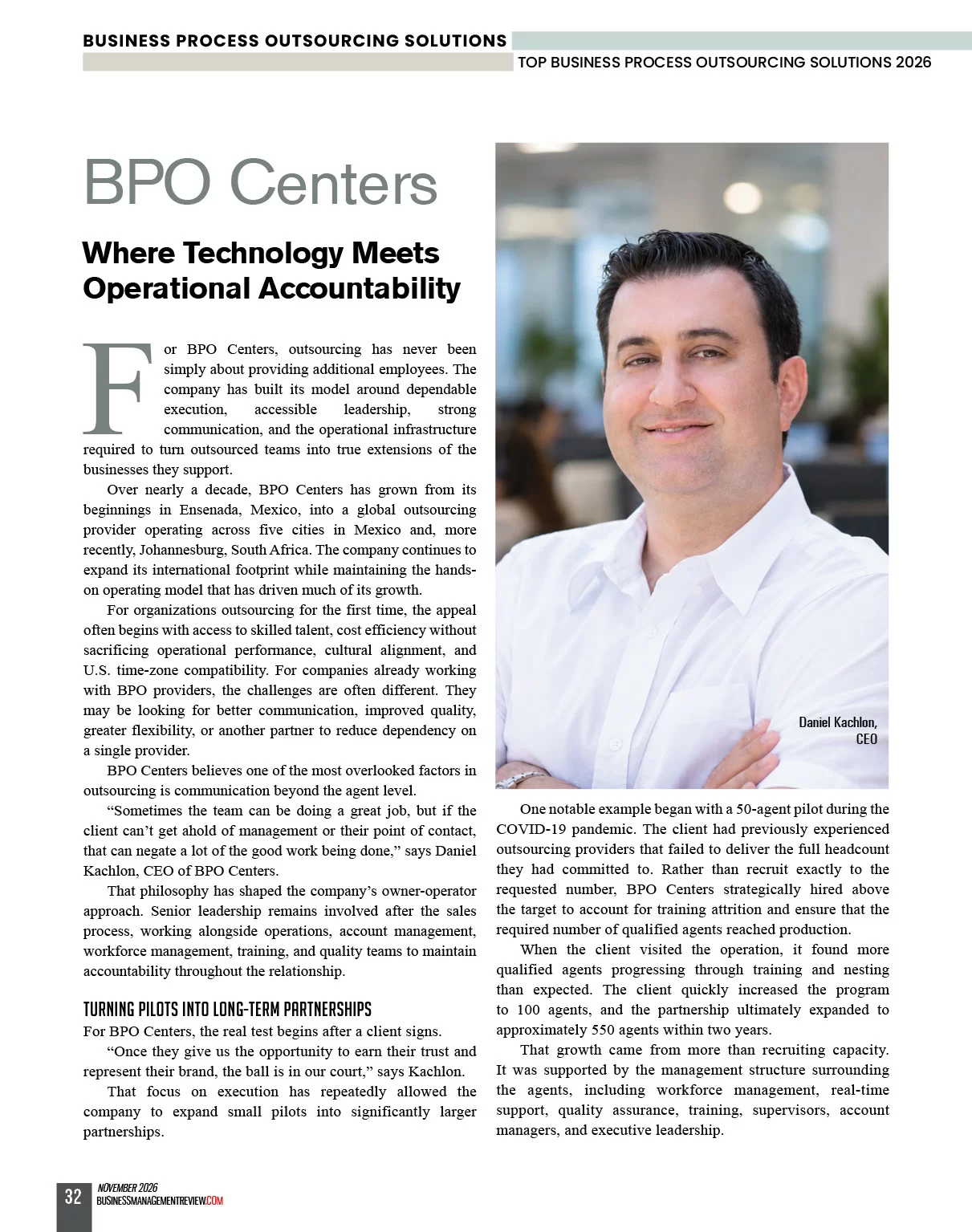
 Daniel Kachlon, CEO
Over nearly a decade, BPO Centers has grown from its beginnings in Ensenada, Mexico, into a global outsourcing provider operating across five cities in Mexico and, more recently, Johannesburg, South Africa. The company continues to expand its international footprint while maintaining the hands-on operating model that has driven much of its growth.
For organizations outsourcing for the first time, the appeal often begins with access to skilled talent, cost efficiency without sacrificing operational performance, cultural alignment, and U.S. time-zone compatibility. For companies already working with BPO providers, the challenges are often different. They may be looking for better communication, improved quality, greater flexibility, or another partner to reduce dependency on a single provider.
BPO Centers believes one of the most overlooked factors in outsourcing is communication beyond the agent level.
“Sometimes the team can be doing a great job, but if the client can’t get ahold of management or their point of contact, that can negate a lot of the good work being done,” says Daniel Kachlon, CEO of BPO Centers.
That philosophy has shaped the company’s owner-operator approach. Senior leadership remains involved after the sales process, working alongside operations, account management, workforce management, training, and quality teams to maintain accountability throughout the relationship.
Turning Pilots Into Long-Term Partnerships
For BPO Centers, the real test begins after a client signs.
“Once they give us the opportunity to earn their trust and represent their brand, the ball is in our court,” says Kachlon.
That focus on execution has repeatedly allowed the company to expand small pilots into significantly larger partnerships.
One notable example began with a 50-agent pilot during the COVID-19 pandemic. The client had previously experienced outsourcing providers that failed to deliver the full headcount they had committed to. Rather than recruit exactly to the requested number, BPO Centers strategically hired above the target to account for training attrition and ensure that the required number of qualified agents reached production.
When the client visited the operation, it found more qualified agents progressing through training and nesting than expected. The client quickly increased the program to 100 agents, and the partnership ultimately expanded to approximately 550 agents within two years.
That growth came from more than recruiting capacity. It was supported by the management structure surrounding the agents, including workforce management, real-time support, quality assurance, training, supervisors, account managers, and executive leadership.
Using AI To Make People Better
As artificial intelligence reshapes customer operations, BPO Centers has focused on using the technology to improve human performance rather than viewing AI solely as a replacement for people.
-
Sometimes the team can be doing a great job, but if the client can’t get ahold of management or their point of contact, that can negate a lot of the good work being done.
The company has introduced AI across multiple stages of the employee lifecycle, including recruiting, assessments, training, coaching, and quality monitoring.
One of the most impactful applications is AI-powered simulation. Agents can practice realistic customer conversations before entering the live environment while learning to navigate the client’s systems and workflows. The goal is to create a virtual nesting environment where employees can encounter real-world situations without real-world consequences.
BPO Centers has found that this preparation can improve confidence, quality, and readiness as agents transition from classroom training into production. The same technology can also support ongoing coaching by allowing experienced agents to practice more complex scenarios.
AI has also expanded what is possible in quality assurance. Traditional QA models often rely on reviewing a limited sample of customer interactions. Through AI-enabled quality technology, BPO Centers can screen up to 100% of interactions when appropriate, giving quality and coaching teams a broader view of agent performance.
The technology does not replace the QA function. Instead, it helps human quality teams identify trends faster and focus their attention where coaching can have the greatest impact.
 BPO Centers has also developed conversational AI capabilities that can handle the opening stages of customer interactions, gather information, and resolve simpler requests before transferring more complex situations to a human agent.
Kachlon says clients using conversational AI have not necessarily reduced their human teams. In some cases, BPO Centers has continued to expand agent headcount while automation was being introduced, reinforcing the company’s belief that AI and human labor can work together rather than exist in opposition.
Growth With A People-First Culture
As BPO Centers expands globally, the company remains committed to the culture that helped shape its early growth.
Employees regularly participate in volunteer initiatives supporting local orphanages in the communities where BPO Centers operates. The company also supports employee well-being through mental health programs and access to psychologists.
Recognized as a Top Business Process Outsourcing Solutions 2026, BPO Centers continues to expand its global footprint and technology capabilities without losing the operating philosophy that drove its early growth: earn trust, deliver what was promised, and let performance create the next opportunity.
Evaluating Business Process Outsourcing beyond the Labor Rate
Outsourcing decisions often turn on a simple question that is harder to answer than it appears. Can a provider lower cost without creating new problems in service quality, communication, workforce stability or management access? The issue becomes sharper when a company already uses one or more BPO partners. Adding another provider may be about redundancy, but it may also expose weak management access, language friction, uneven performance or attrition that has been tolerated too long.
Cost still matters, though a headline labor rate says little about the full economics of a program. A useful comparison should account for the people surrounding the front line, including training support, quality oversight, workforce management and account leadership. A lower rate can lose its appeal when the client has to compensate for slow escalation, poor scheduling discipline, weak coaching or thin account oversight. Executives should examine how the provider supports the team after launch, not just how quickly it can staff seats.
Communication deserves equal weight because it directly affects how problems are contained. Strong service delivery can still feel unreliable when client contacts are difficult to reach or slow to respond. That makes governance a practical buying factor rather than an administrative detail. Buyers should look at who owns the account, how accessible decision-makers are, what happens when performance slips and whether the provider can act before a minor issue becomes a recurring one.
Workforce quality is another area where surface-level metrics can mislead. Hiring volume matters, but the more useful questions concern how candidates are screened, how agents are prepared before handling live interactions, how coaching continues after training and how attrition is managed. A provider that can protect staffing levels while maintaining call quality gives the client more room to scale without repeatedly rebuilding the team.
“BPO Centers applies AI to recruiting, interviews, training and quality assurance, including roleplay environments that prepare agents before live calls and ongoing coaching.”
Technology is now part of that evaluation, though it should be judged by the work it improves rather than by the number of AI tools attached to the service. Useful applications can strengthen recruiting, improve training practice, expand quality review and handle routine portions of customer interactions. The important distinction is whether automation supports human performance and customer flow or merely removes labor. Buyers should also examine how conversational AI hands work back to human agents when a call moves beyond simple information capture or routing.
Geography adds another layer to the decision. Nearshore delivery can reduce time-zone and language friction, while a broader location mix may give clients more flexibility across coverage windows and cost structures. The strongest providers connect location strategy to the work itself rather than treating each delivery center as interchangeable.
BPO Centers fits this buying logic through a service model built around nearshore delivery, direct account involvement, workforce support and AI used inside the work rather than around it. Its delivery footprint spans five cities in Mexico and Johannesburg, adding flexibility across cost structures and coverage windows. BPO Centers applies AI to recruiting, interviews, training and quality assurance, including roleplay environments that prepare agents before live calls and ongoing coaching. Its quality process uses AI across all calls to make human review more efficient, while conversational AI can handle basic intake before transferring more involved interactions to an agent. For buyers comparing BPO partners on communication, workforce support, delivery flexibility and practical AI use, it merits close consideration.
...Read more
Business Process Outsourcing Solutions Info
Q1
What Do Business Process Outsourcing Solutions Include?
Business Process Outsourcing Solutions allow organizations to assign selected business functions to an external provider rather than manage every activity internally. These arrangements can cover customer service, workforce management, training, quality assurance and other customer-facing operations. Depending on the engagement, a provider may supply trained personnel, management oversight and technology to support daily work. The objective is to maintain reliable service while giving internal teams more room to concentrate on their core responsibilities. Clear service expectations, communication channels and performance measures help establish accountability.
Q2
How Does BPO Centers Approach Business Process Outsourcing Solutions?
BPO Centers combines outsourced staffing with hands-on management and technology-supported delivery. Founded in Ensenada, Mexico, the company has expanded to five cities in Mexico and Johannesburg, South Africa. Its owner-operator model keeps senior leadership involved beyond the sales process, working alongside operations, account management, workforce management, training and quality teams. This structure reflects its emphasis on accessible management and consistent communication. For organizations evaluating Business Process Outsourcing Solutions, the example illustrates why leadership involvement and the infrastructure supporting frontline employees matter alongside staffing capacity.
Q3
When Can Outsourcing Improve Customer Service Operations?
Outsourcing can help organizations address staffing gaps, accommodate changing workloads and establish additional capacity without building every function internally. Business Process Outsourcing Solutions may also provide access to specialized training, quality monitoring and supervisory support. However, adding personnel alone does not guarantee better customer experiences. Organizations should assess whether the provider can meet staffing commitments, maintain service standards and respond quickly when issues arise. Defined escalation paths and regular performance reviews help both parties identify problems before they affect service delivery, customer satisfaction or the consistency of daily operations.
Q4
What Role Does AI Play in Outsourced Business Processes?
Artificial intelligence can support recruiting, employee assessments, training, coaching and quality assurance. Within Business Process Outsourcing Solutions, these applications can help teams prepare employees for customer interactions and identify performance patterns across a larger share of conversations. AI-powered simulations allow agents to practise realistic scenarios before handling live requests, while automated monitoring can help quality teams review interactions more broadly. Human oversight remains important for interpreting results, addressing complex situations and delivering useful coaching. Organizations should evaluate how technology supports employee performance rather than judge its value solely by the amount of work automated.
Q5
How Does BPO Centers Use Technology to Support Service Quality?
BPO Centers uses AI-powered simulations to help agents practise customer conversations and learn client workflows before entering live operations. The company also applies AI-enabled quality technology to screen up to 100% of interactions when appropriate, helping its quality teams identify trends and direct coaching. Its conversational AI capabilities can manage initial exchanges, collect information and resolve simpler requests before transferring more complex matters to human agents. These documented applications show how Business Process Outsourcing Solutions can combine automation with human judgment to support readiness, monitoring and customer service continuity.
Q6
What Should Organizations Evaluate Before Choosing an Outsourcing Partner?
Organizations should examine staffing plans, training methods, management accessibility, quality assurance and the provider's ability to scale without weakening service standards. Business Process Outsourcing Solutions should also be assessed against communication expectations, workforce stability, technology governance and measurable performance goals. A pilot engagement can reveal whether recruitment capacity, supervision and reporting processes are sufficient before a larger commitment is made. Buyers should clarify who handles escalations, how service issues are resolved and which indicators determine success. These checks help establish a working relationship built around realistic expectations and sustained accountability.
Company :
BPO Centers
ManagementDaniel Kachlon, CEO
Description
BPO Centers delivers business process outsourcing solutions through skilled teams, hands-on operational leadership and AI-enabled technology. With operations across Mexico and South Africa, the company helps clients improve customer experience, scale efficiently and build high-performing outsourced teams.